
Hiring a good React developer shouldn't take a quarter and a recruiter's fee. But between sorting through marketplace profiles and long recruiting cycles, it often does. Here's a practical path to a dedicated React developer who is vetted, ready and works with your team long term, with no search fee.
First, get clear on what you need
Before you talk to anyone, answer four questions. They'll save you weeks.
- Seniority. Do you need someone to ship features under your lead (mid), own complex work independently (senior), or set the architecture (lead)?
- Scope of the React work. Pure frontend? Full-stack with Next.js and API routes? Performance and Core Web Vitals? "React developer" covers a lot of ground.
- Engagement. Full-time, part-time, or hourly? Long-term or a single push?
- Timezone. How much working-hours overlap do you actually need with your team?
A clear answer here turns a vague "we need a React dev" into a brief a partner can match in days. If the role is broader than React, with Node.js or plain JavaScript work, our guide on how to hire dedicated JavaScript developers covers that side.
Where to find dedicated React developers
You have three realistic options, each with a trade-off.
Freelance marketplaces. Big pool, low floor. You'll find talent, but you're doing all the vetting, and reliability is hit or miss. Workable for a small, low-risk task; risky for core product work. In-house hiring. Highest control, highest cost and slowest. Recruiting, interviews, benefits, equipment, and 1–3 months of ramp-up before they're productive. Worth it for a permanent core hire — overkill if you just need capacity. Staff augmentation. A partner sources and vets developers, then hands you matched, dedicated profiles who work with your team. Your team sets priorities; the engineer stays contracted and paid through the partner. You skip the sourcing grind and the search fee. For most teams scaling a product, this is the fastest route to a reliable hire. You can hire dedicated React developers this way and review profiles in days, not months.
How to vet a React developer (the parts that matter)
A polished CV tells you almost nothing. Check these instead:
- Live coding, not take-homes alone. Watch how they think through a real React problem — state, component structure, data flow.
- Real product work. Ask for shipped projects, not just tutorials or clones. Have they handled performance, accessibility, and edge cases in production?
- Communication. A senior dev who can't explain a trade-off clearly will slow your whole team. Test English and clarity in the interview.
- Modern React fluency. Hooks, state management, performance patterns, and ideally Next.js if SSR or SEO matters to you.
- Culture and ownership. Do they ask good questions about your product, or just wait for tickets?
A good partner will have already done this for you — every profile you see should come pre-vetted on exactly these points, so you interview finalists, not a pile of CVs. If your app runs on Next.js, our guide on how to hire dedicated Next.js developers covers the App Router, caching and server-side skills to check.
Engagement models, briefly
- Embedded/dedicated. Full-time on your team, long-term delivery. Best when React is central to your product.
- Part-time augmentation. Extra capacity for a push or a spike, scaled down after.
- Feature delivery. A defined scope — an SSR migration, a performance pass — with a clear timeline.
The right one depends on whether you need ongoing capacity or a finite piece of work.
Red flags to walk away from
- No trial or replacement. If a partner won't stand behind the match, that tells you something. Look for a free replacement window.
- Opaque pricing. Surprise platform fees or vague "it depends" rates are a bad sign. You should get clear hourly or monthly numbers.
- Rotating developers. If you can't keep the same person who learned your codebase, continuity (and quality) suffers.
- Juniors billed as seniors. Ask directly about seniority and verify it in the interview.
What it should cost
A vetted mid-to-senior React developer through staff augmentation is billed at a published hourly rate, with no search fee on top. We broke the numbers down in our guide on how much it costs to hire a React developer. The headline: you pay one hourly rate for vetted capacity, with no search fee on top.
A simple hiring checklist
- Write a one-paragraph brief (seniority, scope, engagement, timezone).
- Pick your model — marketplace, in-house, or staff augmentation.
- Get 2–3 matched, vetted profiles.
- Run a live coding round and a short culture conversation.
- Start with one developer; scale once the fit is proven.
- Make sure there's a free replacement window before you commit.

Bottom line
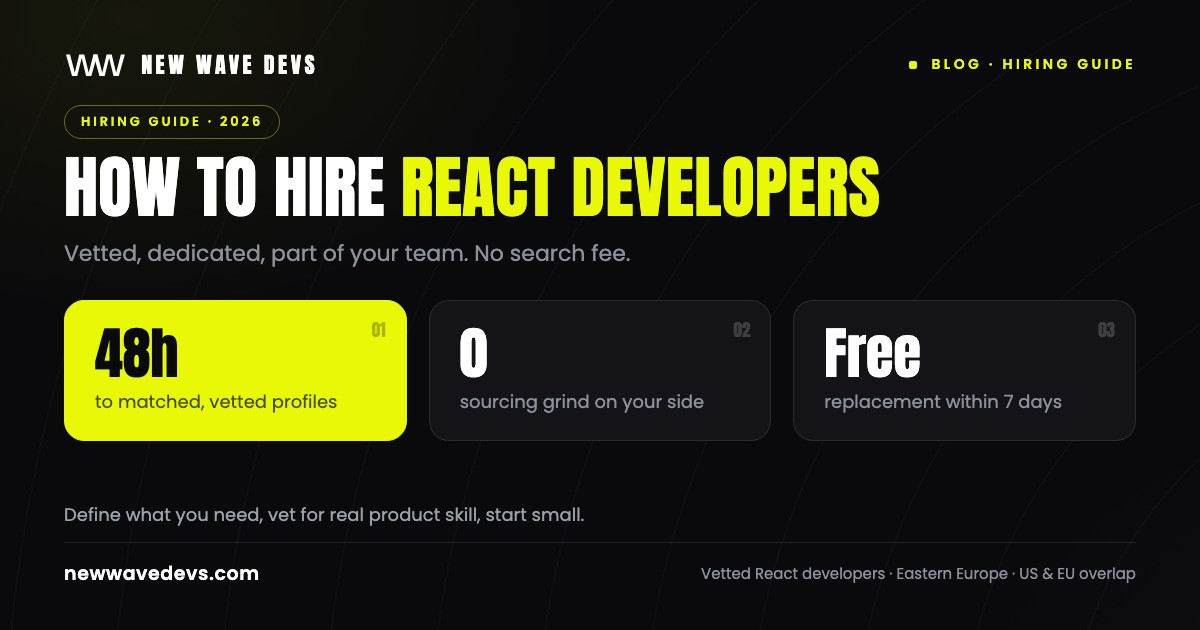
You don't have to choose between cheap-and-risky and expensive-and-slow. With staff augmentation, you get a dedicated React developer who's vetted, integrated into your team, and backed by a free replacement in the first 7 days, with no search fee. Define what you need, vet for real product skill, and start small.
Ready to skip the search? Hire dedicated React developers and get matched profiles in days, not months.
Frequently asked questions
How long does it take to hire a dedicated React developer?With a staff augmentation partner, you can usually review vetted profiles in days, not months and have someone working within days — versus 1–3 months for an in-house hire.
How do I know a React developer is actually senior?Verify it in a live coding round and ask about production work — performance, accessibility, complex state — not just project lists on a CV.
What if the developer isn't a good fit?Choose a partner that offers a free replacement window, so a wrong match doesn't cost you the project timeline.